South Africa’s governing African National Congress (ANC) is heading for its worst election result since the end of apartheid, with just over half of the votes counted in Wednesday’s local government elections putting the party on about 32% of the national vote.
With 53% of votes counted on Thursday night, the Electoral Commission of South Africa (IEC) showed the ANC on 31.83%, narrowly ahead of the Democratic Alliance (DA) on 25.92%, according to the Independent Online (IOL). Former president Jacob Zuma’s uMkhonto weSizwe (MK) Party was a distant third on 8.04%, followed by the Economic Freedom Fighters (EFF) on 5.89%.
The Council for Scientific and Industrial Research (CSIR), which models election trends from the early results, projected the ANC would finish on about 31.7% of the vote, with the DA on 25.7% and the MK Party on 9%.
If those projections hold, it would be a dramatic fall from the 45.59% the ANC won at the last local elections in 2021 — itself then its worst result — and from the 40.18% it won at the 2024 general election, when it lost its parliamentary majority for the first time and was forced into a coalition government.
A party in retreat across the country
The ANC has governed South Africa since the end of apartheid in 1994, but its support has weakened in successive elections amid criticism over corruption, high crime, unemployment and persistent failures in basic services, including electricity and water supply.
The early results suggest that decline is accelerating. Limpopo was the only province where the ANC still commanded more than half of the vote, on 54.28%. In the Eastern Cape, long one of its strongholds, the party had slipped to 46.89%, while it polled 44.77% in North West, 42.19% in Mpumalanga, 41.39% in the Northern Cape and 39.62% in the Free State, IOL reported.
In Gauteng, the country’s economic heartland, the DA was leading in eight of the nine highly contested municipalities, with the ANC ahead in only one, according to TimesLIVE.
The DA was meanwhile performing strongly in several major cities. The CSIR projected the DA would finish first in five of the country’s eight metropolitan municipalities, although it was only expected to win more than half of the vote in Cape Town, where it was projected on 55.90% and its leader, Geordin Hill-Lewis, had already declared victory.
In Johannesburg, the contest for control of the country’s economic hub, the DA was projected on 33.94%, ahead of the ANC. The DA was also projected ahead in Nelson Mandela Bay (40.97%), Tshwane (31.77%) and Ekurhuleni (29.48%).
Hung councils pile up
By the time of publication on Thursday evening, the ANC had won outright control of only 15 of the country’s councils, the DA five and the MK Party two, with 57 councils already hung and 133 still to be calculated, IOL reported.
That points to weeks of coalition negotiations. The Electoral Commission is expected to announce the final results on Sunday, after which parties will have two weeks to negotiate municipal coalitions.
The MK Party, which was ahead of the ANC in KwaZulu-Natal according to early results, was coming third nationally with about 8% — below the levels suggested in opinion polls before the vote.

Turnout rises as voters punish the ANC
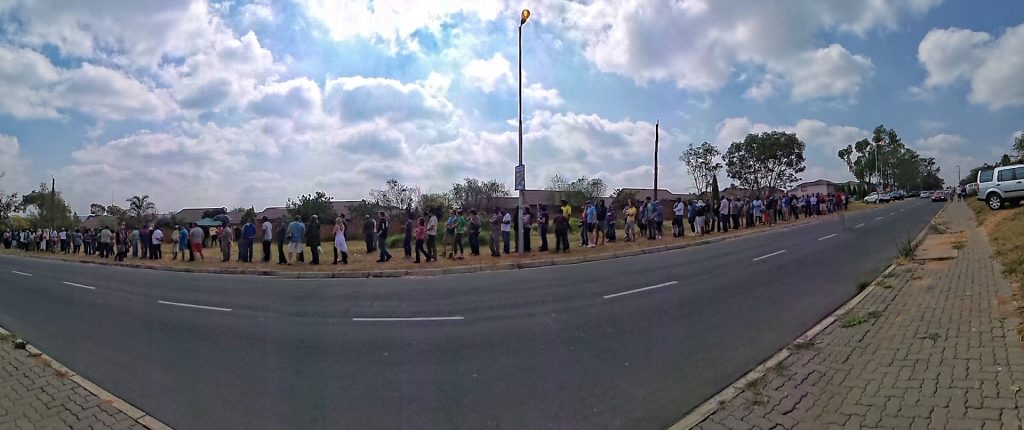
About 15.9 million of South Africa’s 29.2 million registered voters cast ballots, the Electoral Commission said, putting turnout at an estimated 54.5% — up from 46% in the pandemic-hit 2021 local elections.
A total of 136,790 candidates were competing for 10,526 council seats across the country’s municipalities.
The ANC sought to frame the results as an improvement on its 2024 general election showing. The party’s first deputy secretary general, Nomvula Mokonyane, said the ANC would have been in a worse position had these local polls taken place in 2024.
“If you look at 2024 and 2026, had we had local government elections in 2024, we would be in a worse-off situation compared to where we are now,” Mokonyane said, according to TimesLIVE.
But the numbers tell a different story at local level: a drop of about 14 percentage points from the ANC’s 2021 municipal result, with the DA narrowing the gap to about six points and smaller parties — the MK Party, EFF, ActionSA on 4.17% and the Inkatha Freedom Party on 4.04% — eating into its support across the country.
Why this election matters
The local elections are widely seen as a key measure of voter sentiment ahead of the 2029 general election, and as a test of whether the ANC can recover from losing its national majority in 2024.
The party entered a coalition government with the DA and smaller parties after that election, and the local results will shape the balance of power inside that arrangement — as well as who governs South Africa’s biggest cities.
Early results are not always a reliable guide to the final outcome, because votes from urban areas where the DA gets most of its support are tallied first. But the CSIR’s modelling, based on the early official tallies, suggested the picture would broadly hold.
The final results are expected on Sunday. Until then, the emerging figures remain provisional, and the national picture could still change as more voting districts are processed.
What happens next
– The IEC is expected to announce the final results on Sunday, 8 November.
– Parties will then have two weeks to negotiate coalitions in hung councils.
– The DA is expected to retain Cape Town, while control of Johannesburg, Tshwane and Ekurhuleni will be decided in coalition talks.
– The results will feed into the debate inside the ANC about its direction ahead of the 2029 general election.
FAQ
What share of the vote is the ANC on?
With about 53% of votes counted on Thursday night, the ANC was on 31.83% nationally, according to the Electoral Commission. The CSIR projected it would finish on about 31.7%.
Is this the ANC’s worst election result?
Yes, if the projections hold. It would be below the 45.59% the ANC won at the 2021 local elections and the 40.18% it won at the 2024 general election — its worst result since it came to power in 1994.
When will the final results be announced?
The Electoral Commission is expected to announce the final results on Sunday. Parties then have two weeks to negotiate coalitions in hung councils.
Who is leading in the big cities?
The DA is projected to finish first in five of the eight metropolitan municipalities, including Cape Town, where it is expected to win more than half the vote, and Johannesburg, where it is projected on about 34%.
Why is ANC support falling?
Voters have cited corruption, high crime, unemployment and failures in basic services such as electricity and water. The ANC has governed South Africa since 1994 but lost its parliamentary majority in 2024.
Sources
– BusinessDay — “ANC support plunges in South Africa municipal elections as DA gains” (5 Nov 2026): https://businessday.ng/africa/article/anc-support-plunges-in-south-africa-municipal-elections-as-da-gains/?amp
– IOL — “Halfway count spells trouble for ANC as DA narrows gap to six points” (5 Nov 2026): https://iol.co.za/lge2026/2026-11-05-halfway-count-spells-trouble-for-anc-as-da-narrows-gap-to-six-points/
– TimesLIVE — “Mokonyane says ANC would be ‘worse off’ if local polls were in 2024” (5 Nov 2026): https://www.timeslive.co.za/politics/2026-11-05-mokonyane-says-anc-would-be-worse-off-if-local-polls-were-in-2024/
– Fullview — “ANC loses ground in local govt elections, modelling shows” (5 Nov 2026): https://fullview.co.za/anc-loses-ground-in-local-government-elections-modelling-shows/
– Modern Ghana (AFP) — “South Africa’s ANC heading to new lows after local polls” (5 Nov 2026): https://www.modernghana.com/news/1542319/south-africas-anc-heading-to-new-lows-after-local.html