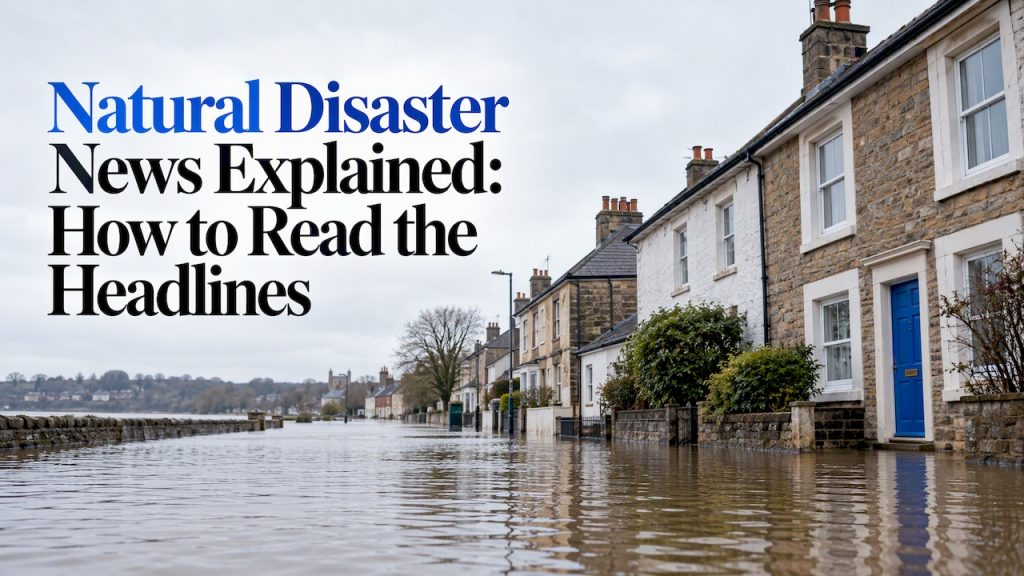
Natural disaster news reports hazards such as floods, earthquakes, storms and wildfires, and what they did to people and property. Reading it well depends on three things: knowing the difference between a hazard and a disaster, understanding that early casualty and cost figures are estimates, and separating what a forecast says from what has already happened. This guide covers each in plain English, with the official definitions and current data behind them.
TL;DR
- A natural hazard is the event. A disaster is what happens when that event meets people who are exposed and unable to cope, according to UN disaster-risk definitions.
- Early death tolls and loss figures change. Treat the first number as a preliminary estimate, not a final count.
- Climate change is increasing the intensity and frequency of extreme weather, but exposure and vulnerability decide how severe the human impact becomes.
- Seasonal outlooks describe probabilities for regions and months. They are not predictions of specific events.
- Check who issued a figure, what period it covers and whether it is insured, economic or human loss.
Table of Contents
- What counts as a natural disaster
- The main types of natural disaster
- How disasters affect people and the environment
- Climate change and disasters: what the evidence says
- How to read disaster updates and impact figures
- Where the latest disaster updates come from
- Perspective
- Follow the story with Emadan
- FAQ
- Sources
What counts as a natural disaster
Headlines often use “natural disaster” for any dramatic weather or geological event. Scientists and humanitarian agencies are more precise, and the distinction explains much of what appears in the news.
The U.S. Geological Survey describes a natural hazard as an event with the potential to cause harm, and a natural disaster as the realisation of that danger when it strikes a population and causes actual loss of life or property. An earthquake under an uninhabited region is a hazard. The same earthquake under a dense city is a disaster.
The UN Office for Disaster Risk Reduction (UNDRR) goes further. It defines a disaster as a serious disruption caused by hazardous events interacting with exposure, vulnerability and capacity, leading to human, material, economic or environmental losses. The same page notes that “emergency” is sometimes used interchangeably with “disaster”, but an emergency can arise without serious disruption to a community. A disaster may test or exceed a society’s capacity and may require external assistance.
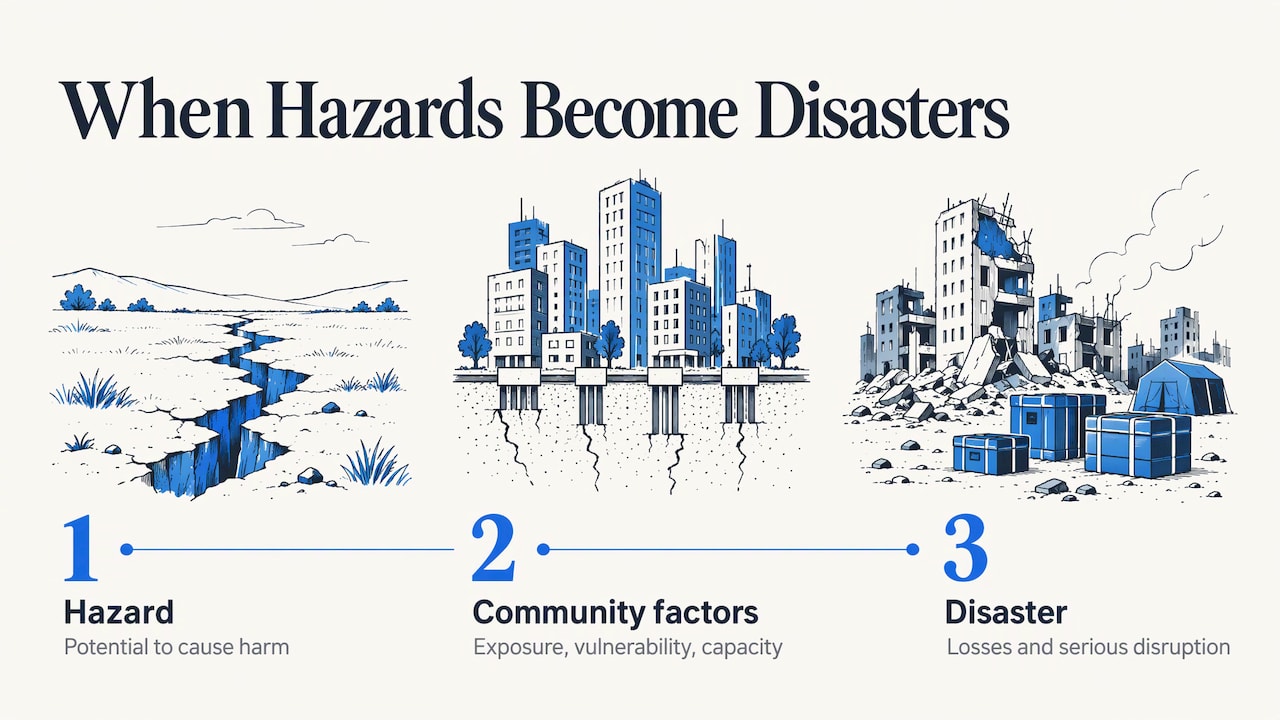
This is why two similar events can produce very different news. Earlier UN work on disaster reduction made the point that hazards are natural phenomena that become disasters only when they meet vulnerable socio-economic systems lacking the capacity to cope. The USGS adds that risk can be reduced, for example by building to withstand earthquake shaking or by moving away from the hazard.
The main types of natural disaster
The UN’s disaster-reduction framework lists the hazards that most often become disasters: earthquakes, volcanic activity, landslides, tsunamis, tropical cyclones and other severe storms, floods, wildfires and drought. They fall into three broad groups, which helps when deciding how fast a story may develop.
| Group | Examples | How news usually unfolds |
|---|---|---|
| Geological | Earthquakes, volcanic eruptions, tsunamis, landslides | Sudden onset. Little or no warning for earthquakes. Aftershocks and secondary hazards follow. |
| Weather-driven | Tropical cyclones, severe storms, floods, tornadoes | Forecast days ahead. Coverage runs from warnings to landfall to recovery. |
| Climate-related and slow-onset | Drought, heatwaves, wildfire seasons | Build over weeks or months. Impact figures may take far longer to appear. |
Slow-onset hazards are easy to underestimate in the news cycle because there is no single dramatic moment. Heatwaves are an example. A first-half 2026 disaster review states that heatwaves are now regarded as the natural hazard that claims the most lives, even though they rarely produce the images that floods or earthquakes do.
Compound events also matter. Floods can follow drought because dry ground absorbs less water. Wildfires, identified by UNDRR as a primary driver of global forest loss, also degrade watersheds and raise the future likelihood of landslides and floods.
For a recent example of a weather story with a specific local risk, see our report on the storm threatening flash flooding in the Four Corners region and a soggy Election Day across the central US.
How disasters affect people and the environment
UNDRR describes the effects of disasters as including death, injury, disease, destruction of physical assets, disruption of basic services and damage to livelihoods. The headline usually carries the deaths and the building damage. The longer-term effects arrive in later reports, and they matter just as much.
The scale over a longer period is large. UNDRR’s review of 2000 to 2019 recorded 6,681 climate-related disasters that caused over 510,000 deaths and affected 3.9 billion people. Those totals show why a single year’s figure should be read against a long-run average rather than in isolation.
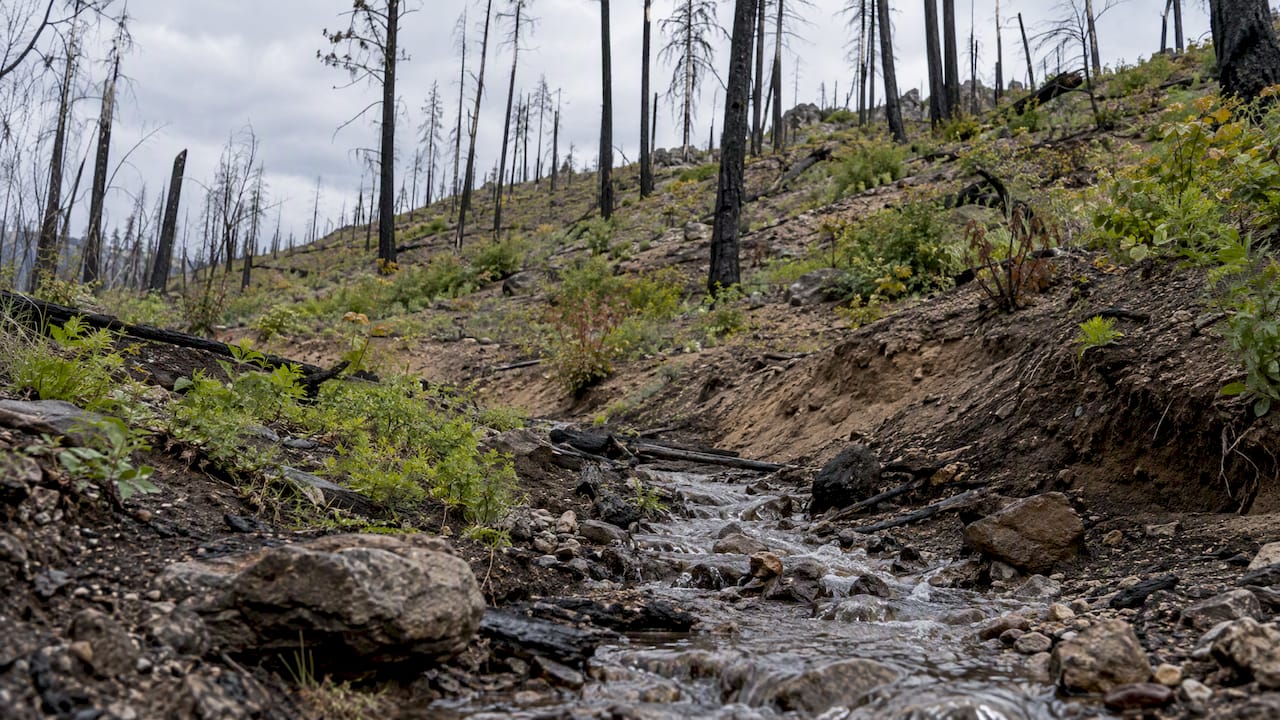
Environmental damage feeds back into risk. An academic paper published through the UN’s global platform for disaster risk reduction argues that healthy ecosystems contribute to disaster risk reduction, while disasters can diminish ecosystem services and so increase later risk. In practice, a story about a burned hillside or a damaged wetland can be an early indicator of the next flood or landslide.
Not every disaster is a purely natural story. Mountain-rescue and avalanche services are part of how societies manage hazard risk, and changes to them are news in their own right. Our report on Canada ending its 55-year avalanche dog programme in the Rocky Mountains is one such case.
Climate change and disasters: what the evidence says
Climate stories and disaster stories overlap, and readers often ask how closely. The evidence supports a firm link for some hazards and a more cautious one for others.
The WWF states that climate change is increasing the intensity and frequency of extreme weather, which often results in disasters. On heat, a UN-partnered report found that heat-related deaths reached an estimated 710,000 globally in 2023, with more than 70% attributed to human-caused climate change. The same UN source reports that WMO data released in October 2026 show atmospheric concentrations of carbon dioxide and other greenhouse gases reached record highs in 2025.
UNDRR warns about the longer term: a 3°C rise in global average temperature is estimated to significantly increase the frequency of high-impact hazard events, potentially making current local and national risk-reduction strategies obsolete.
What climate change cannot explain alone
A hazard’s strength is only part of any disaster. Exposure and vulnerability are the rest. A UNDRR regional assessment for the Arab region argues that climate discussion began with a focus on biophysical models and largely obscured socioeconomic and political processes, and that exposure and vulnerability are structurally determined. The academic literature adds that environmental degradation is a key driver of disaster risk.
So when a headline says a storm was “made worse by climate change”, the careful reading is this: the climate signal may have raised the hazard, while housing quality, drainage, warning systems and income decided how many people were harmed. Insurers make a similar point. Munich Re says numerous studies indicate that climate change increases the frequency or severity of weather disasters, and that many extreme events in 2025 were likely influenced by it. Note the wording: “likely influenced”, not “caused”. Attribution of a single event is a specialised scientific exercise and usually appears days or weeks after the event.
How to read disaster updates and impact figures
This is where most confusion arises. Four habits make disaster coverage much easier to follow.
Treat early numbers as provisional
Disaster fatality data are, as one analysis in Eos puts it, interpreted, classified, attributed, verified and revised rather than simply collected. Definitions, thresholds and reporting practices can all change what is recorded. In the first hours, tolls typically rise as search teams reach remote areas. Weeks later, indirect deaths from disease, heat or disrupted healthcare may be added or debated. A revised figure is not necessarily a correction of an error. Often it reflects better information.
Know which kind of loss is being quoted
Three different totals appear in headlines, and they are not interchangeable:
- Economic losses: the estimated total cost of damage and disruption.
- Insured losses: the part covered by insurance, which is always smaller.
- Human impact: deaths, injuries, people displaced or “affected”, where “affected” is defined differently by different agencies.
The first-half 2026 review is a useful illustration. It estimated worldwide disaster losses at nearly US$112bn, of which only US$44bn were insured, a 60% insurance gap. It also reported that those losses were slightly below the inflation-adjusted ten-year average and well below the five-year average. A “lower loss” half-year says little about risk if the hazards are growing, and the review’s own title makes that point.
Compare with a long-run average
A single year can look catastrophic or mild because of luck. Our World in Data’s analysis states that disasters kill approximately 10,000 to 20,000 people per year globally, excluding temperature-related deaths. That is a baseline against which to read any one event, though it varies sharply year to year, and a single earthquake or cyclone can exceed it.
Distinguish forecasts from events
Seasonal outlooks give probabilities for broad regions. The WMO’s Global Seasonal Climate Outlook for November 2026 to January 2027 says sea surface temperatures in the tropical Pacific could rise to 3.8°C above average, a level the WMO notes as unprecedented in four decades of monitoring. The outlook also points to wetter-than-normal conditions in parts of East Africa during October to December, drier conditions that could affect Southern African crops from November, and warmer, drier conditions in Southeast Asia that raise heat, wildfire and smoke-haze risks.
Those are risk signals, not forecasts of named disasters. They help humanitarian agencies prepare, and they help readers judge why certain regions appear repeatedly in coming weeks. When a story says a region “faces” a risk, check whether it cites an outlook, a short-range weather warning or an event already under way.
Where the latest disaster updates come from
To follow live developments, it helps to know what each type of source offers. Satellite agencies such as NASA publish Earth-observation data on floods, droughts and cyclones. Meteorological bodies issue warnings. UN agencies and humanitarian organisations publish situation reports. Insurers and reinsurers publish loss estimates months later.
A good rule is to ask three questions of every update: who measured it, when, and has the figure been revised since? Stories that answer all three are usually more reliable than those that quote a single unattributed number.
Perspective
At Emadan, we think disaster coverage fails readers in two ways: it either shouts or it buries the point in jargon. Our approach is to give the plain-English explanation first: what happened, where, how many people are affected, and what is still unknown.
We build stories around the checks described above. We state which agency issued a figure, say when it is preliminary, and keep background context beside the headline so a student or a busy professional can follow the story without prior knowledge.
We also avoid sensational framing. A disaster is serious enough without exaggeration, and a reader who is told clearly what is confirmed, what is estimated and what is forecast is better informed than one who is simply alarmed. Where facts change, we correct promptly and keep our editorial judgement independent.
ISSB
Follow the story with Emadan
Emadan publishes global news in plain English, with quick-answer summaries, key takeaways, background context and FAQs on business, politics, science, technology, sports and world events. Disasters rarely stay in one category: a storm becomes an insurance story, a drought becomes a food-price story, a wildfire becomes a health story.
Browse the latest reports on the Emadan home page, and see how we explain the economic side of events in our guide to economic news and how to read the headlines.
FAQ
What is the difference between a natural hazard and a natural disaster?
A hazard is an event with the potential to cause harm, such as an earthquake or a flood. A disaster is what follows when that event strikes people and causes real loss of life or property, according to the U.S. Geological Survey. The same hazard can be harmless in one place and disastrous in another.
Why do death tolls change after a disaster?
Counting is difficult and slow. Deaths are identified, classified, attributed and later revised, and different agencies use different definitions, as the Eos analysis of fatality data explains. Initial tolls usually rise as rescuers reach remote areas, and they can also change when indirect deaths are assessed.
Is climate change causing more natural disasters?
The evidence points to more intense and frequent extreme weather, according to the WWF. Climate change does not act alone, though. Whether a hazard becomes a disaster also depends on exposure, vulnerability and the capacity to cope, as UN definitions make clear.
What do seasonal climate outlooks tell us?
They give the likelihood of warmer, wetter or drier conditions across regions and months. The WMO outlook for November 2026 to January 2027 is used to inform humanitarian preparation. It is a guide to risk, not a prediction of any particular storm, flood or fire.
Sources
- Definition: Disaster | UNDRR
- EarthWord–Hazard | U.S. Geological Survey
- Countering Disasters, Targeting Vulnerability | UNISDR
- The invisible costs of wildfire disasters in 2025 | UNDRR
- An overview of the last 20 years | UNDRR
- Disaster-related losses of ecosystems and their services
- Climate Change | UN News
- Is Climate Change Increasing Disaster Risk? | WWF
- Vulnerabilities and capacities in climate change mitigation | UNDRR, Arab region
- WMO Global Seasonal Climate Outlook informs humanitarian action
- Lower losses, growing risks: the disaster review for the first half of 2026 | PreventionWeb
- Why counting disaster fatalities is harder than it looks | Eos
- Natural Disasters | Our World in Data
- Natural Hazards | NASA Earthdata
Recommended
- Storm Threatens Flash Flooding in Four Corners and Soggy Election Day Across Central US
- Hurricane Trudy Becomes Category 2 Storm Off Mexico’s Coast
- Canada Ends 55-Year Avalanche Dog Programme in Rocky Mountains