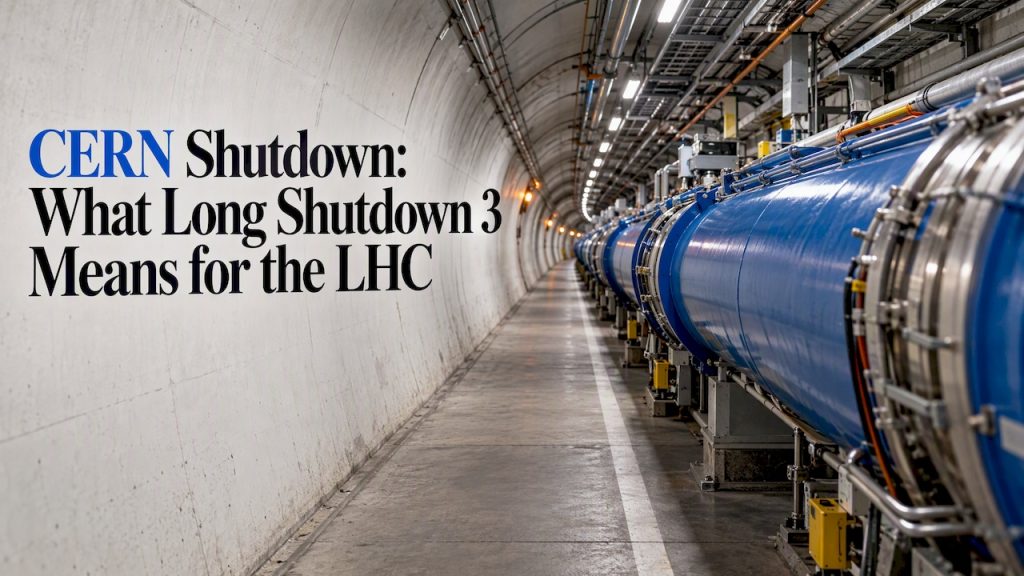
CERN has not closed. The Large Hadron Collider (LHC), its largest machine, was switched off on 29 June 2026 to begin Long Shutdown 3 (LS3), a planned multi-year programme of maintenance, consolidation, upgrades and installation. The work prepares the machine for the High-Luminosity LHC, known as HiLumi LHC, which is scheduled to begin operation in 2030. Until then no particle beams circulate in the LHC, but scientists keep analysing data and the laboratory stays open.
TL;DR
- The LHC was switched off on 29 June 2026. This is a scheduled upgrade period called Long Shutdown 3, not a closure of CERN and not a response to a fault.
- Teams are removing about 1.2 kilometres of the accelerator and installing new HiLumi LHC equipment, which is designed to raise luminosity by up to a factor of 10.
- The wider accelerator complex returns progressively from 2028 onwards, and the HiLumi LHC is scheduled to restart in mid-2030.
- Research continues during the shutdown: the experiments are being upgraded and the Run 3 datasets are still being analysed.
Table of Contents
- What the CERN shutdown actually means
- Is CERN shutting down in 2026?
- Why the LHC is being shut down
- What work is happening during Long Shutdown 3
- What happens to research while the LHC is off
- Has CERN done this before?
- What does CERN stand for?
- Debunking the rumours around the shutdown
- Perspective
- Follow the story with Emadan
- FAQ
- Sources
What the CERN shutdown actually means
In everyday language, “shut down” suggests that something has stopped working or closed for good. At CERN the term has a narrower meaning. The accelerators are switched off, no beams of particles circulate, and engineers get access to parts of the machine that are normally unreachable because of radiation, cryogenics and the tight schedule of experiments.
CERN’s own overview describes LS3 as a phase in which the entire accelerator complex is shut down for maintenance, consolidation and upgrades. The aim is to provide the reliability and availability needed for the next period of physics. The same page explains that planned shutdowns are a normal part of an accelerator’s life, particularly for machines that operate close to absolute zero, because preventive maintenance, corrective repairs, consolidation and upgrades can be grouped into one period.
The LHC is a ring 27 kilometres in circumference, with thousands of superconducting magnets cooled to extremely low temperatures. Warming up, opening, repairing and cooling such a machine again takes months, so work is done in long blocks rather than in short pauses.
Is CERN shutting down in 2026?
Yes, the LHC is, and the dates are now settled history. Final physics collisions took place on 14 June 2026, followed by about two weeks of circulating beams used for high-intensity tests before the complete shutdown. The LHC was then switched off on 29 June.
The LHC was not the only machine affected. CERN’s update of 31 August 2026 reported that the injector complex and the Antimatter Factory delivered their last beams, following the LHC’s June shutdown. That means the whole chain of accelerators that feeds the LHC is now in the same programme.
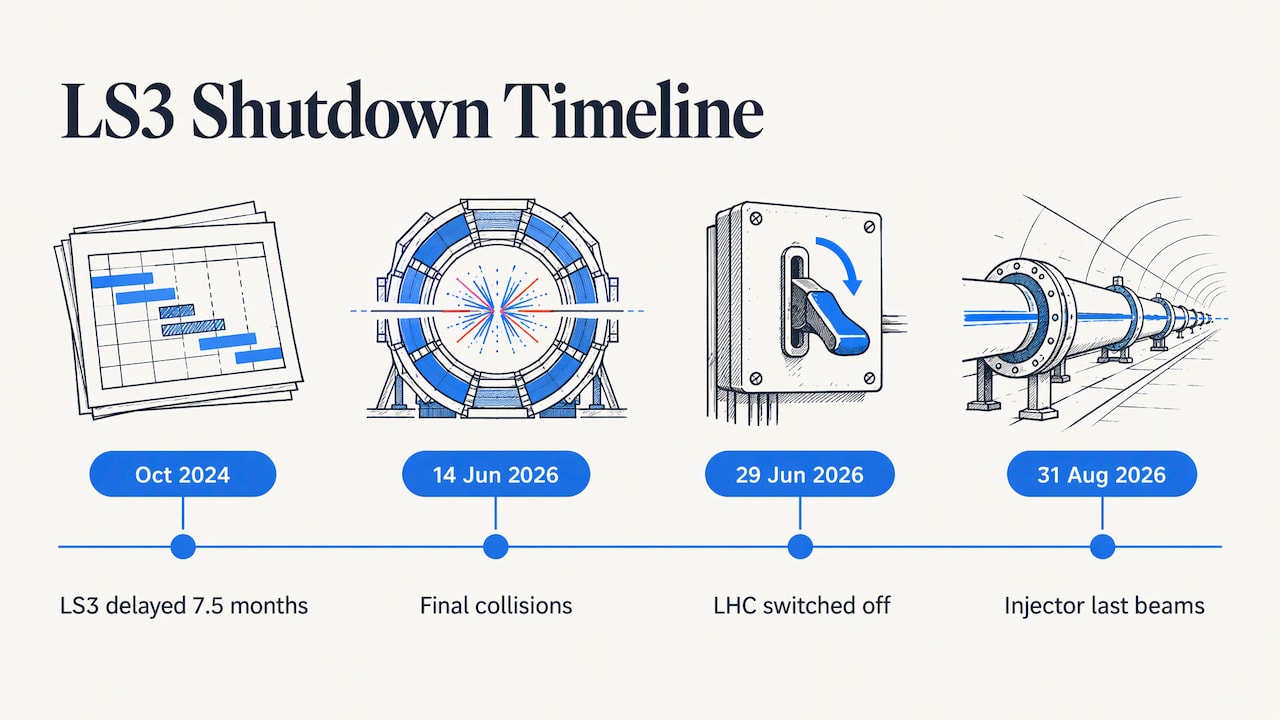
The timing was not always planned for mid-2026. CERN’s 8 October 2024 schedule extended Run 3 until July 2026 and delayed LS3 by seven and a half months compared with the earlier plan. The longer schedule also allows civil-engineering work to connect new HiLumi technical galleries to the LHC tunnel.
Key dates at a glance
| Milestone | Date | What happened or is planned |
|---|---|---|
| Final physics collisions | 14 June 2026 | Last collisions of Run 3 |
| LHC switched off | 29 June 2026 | Start of Long Shutdown 3 |
| Injectors and Antimatter Factory | Summer 2026 | Last beams delivered |
| Accelerator complex restarts | From 2028 | Progressive return to operation |
| HiLumi LHC restart | Mid-2030 | Scheduled start of high-luminosity operation |
The 2028 and 2030 dates are schedules, not guarantees. Large projects of this kind can move, as the 2024 revision showed, so CERN’s LS3 page is the place to check the current plan.
Why the LHC is being shut down
The short answer is luminosity. In collider physics, luminosity measures how many collisions a machine produces over time. CERN’s HL-LHC media kit explains that a higher value lets experiments collect more data and study rarer processes. Because rare events are, by definition, unlikely in any single collision, a larger dataset raises the chance that they appear.
CERN says the HiLumi LHC is designed to increase luminosity by up to a factor of 10 beyond the original LHC design. The expected payoff is much larger datasets for precision studies of the Higgs boson and for searches for physics beyond the Standard Model.
There is also an age factor. The current focusing magnets around ATLAS and CMS date back to the construction phase and were installed between 2005 and 2007. After nearly twenty years of operation, they are being replaced by a new generation.
What work is happening during Long Shutdown 3
The work falls into several strands, all running at once across the CERN sites in Switzerland and France.
Rebuilding sections of the LHC
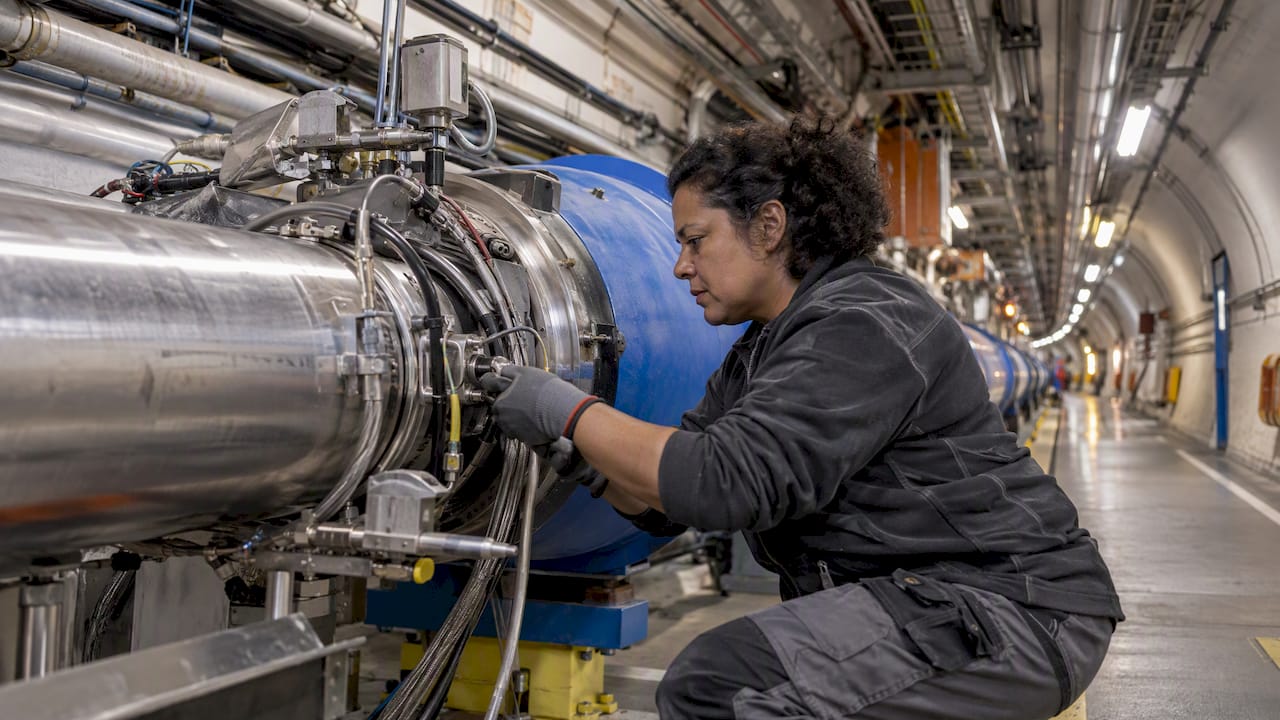
Teams are dismantling about 1.2 kilometres of the accelerator to install new HiLumi LHC equipment. CERN reported in September 2026 that work had begun to disconnect the focusing magnets on either side of the ATLAS and CMS experiments. The new inner triplets use niobium-tin superconducting coils, which can produce magnetic fields of 11.3 tesla, about 40% stronger than those of the present magnets. According to the head of the LS3 coordination team, the first quadrupole of the new triplets is expected in the tunnel at the start of 2029, and 16 cryostats and 28 cryo-assemblies will be installed in total.
New HiLumi equipment
CERN identifies several key items installed or connected during LS3: new, more powerful focusing magnets, superconducting crab cavities, reinforced protection systems and superconducting electrical transmission lines. Crab cavities, in simple terms, tilt the particle bunches so that they overlap more fully at the collision point.
Upgrading the experiments
The shutdown also covers the detectors. The programme includes upgrades to the ATLAS and CMS detectors and trigger systems, along with renovation projects across the accelerator complex and experimental facilities. The trigger is the system that decides in real time which collisions are worth recording, and it has to cope with far higher collision rates once HiLumi starts.
Civil engineering
New technical galleries are being connected to the LHC tunnel. These house equipment for the high-luminosity machine, so that parts of it can be maintained away from the beam line.
What happens to research while the LHC is off
The machines are quiet, but the science is not. CERN says researchers continue analysing accumulated datasets and preparing the experiments during LS3.
The volume of data is large. According to the CMS experiment’s account of the end of Run 3, the run delivered 355 fb−1 of collision data to CMS with 92% recording efficiency, and that dataset will continue to be analysed during the shutdown. The unit, inverse femtobarns, is a measure of the total number of collisions a detector has been exposed to. For readers, the practical point is that new results from Run 3 data can still be published while the collider is dismantled.
The shutdown also affects people. Thousands of engineers, technicians and physicists work on LS3, according to CERN’s LS3 overview, so the sites stay busy even though no beam circulates in the LHC.
Has CERN done this before?
Yes. The LHC started up in 2008 and has been through long shutdowns before. Long Shutdown 2 (LS2) began at the end of 2018, and the collider reopened more than three years later, in April 2022. During LS2, CERN replaced 22 superconducting magnets and installed 16 new collimators in preparation for Run 3 and the HL-LHC.
LS3 is larger in scope. It is expected to last up to four years and involves rebuilding sections of the machine, rather than adding or replacing individual components.
What does CERN stand for?
CERN stands for Conseil Européen pour la Recherche Nucléaire, French for European Council for Nuclear Research. The acronym was born when an agreement establishing a provisional Council was signed, two months after the December 1951 UNESCO meeting. When the organisation formally came into being in 1954, its English name became the European Organization for Nuclear Research, but it kept the acronym. CERN’s own guidance notes that “nuclear” reflects the original focus on the inside of the atom, while modern particle physics goes deeper than the nucleus.
Debunking the rumours around the shutdown
A shutdown of the world’s largest particle accelerator invites speculation online. The facts as published by CERN are plain. The stoppage is a scheduled upgrade, announced years in advance and revised publicly in 2024. The dismantling is documented in CERN’s own news and its purpose is to increase the number of collisions the machine produces. Nothing in CERN’s published material suggests an accident, a closure of the laboratory or a halt to research. When a claim cannot be traced to CERN, an experiment collaboration or a named official, treat it with caution.
Perspective
At Emadan we think the CERN shutdown is a good test of how news should be explained. The headline word, “shutdown”, points readers towards trouble. The reality is a planned, well-documented upgrade with named dates, named equipment and a published purpose.
Our approach is to separate what has happened from what is scheduled. The switch-off on 29 June 2026 is a fact. The 2028 return of parts of the complex and the mid-2030 HiLumi restart are plans, and plans can move, as the 2024 revision showed. A reader who understands that difference is better placed to judge the next headline about any big science project.
We also believe plain English does not mean less accuracy. Terms like luminosity, inner triplet or trigger can be explained in a sentence, with the figure and the source beside them. That is what our quick-answer summaries and key takeaways are designed to do: give students, professionals and everyday readers the verified point first, with background for those who want it.
ISSB
Follow the story with Emadan
Emadan publishes global news in plain English, with quick-answer summaries, key takeaways and background context across science, technology, business and politics. If you want the CERN story explained without jargon, or the next big science headline, start at the Emadan home page.

If you follow science and technology news, our coverage of NASA’s 100th US spacewalk and the seventh ISS solar array is a good companion read. Our report on Anthropic’s AI for Science programme covers how researchers are being offered new tools.
FAQ
What has happened when CERN shuts down?
The accelerators stop circulating beams and engineers begin maintenance, consolidation, upgrades and installation work. In LS3 that includes removing about 1.2 kilometres of the LHC and upgrading the ATLAS and CMS detectors. The laboratory remains open and scientists keep analysing existing data.
Is CERN shutting down in 2026?
The LHC was switched off on 29 June 2026 to start Long Shutdown 3, and the injector complex and Antimatter Factory delivered their last beams in the summer. CERN itself is not closing. The shutdown is a scheduled upgrade, with the HiLumi LHC due to restart in mid-2030.
How long will the shutdown last?
CERN says LS3 is expected to last up to four years. The accelerator complex is due to return progressively from 2028 onwards, and the HiLumi LHC is scheduled to restart in mid-2030. These are planned dates, so check CERN’s official LS3 page for the current schedule.
What does CERN stand for?
CERN comes from the French Conseil Européen pour la Recherche Nucléaire, meaning European Council for Nuclear Research. The organisation’s formal English name is the European Organization for Nuclear Research. It kept the acronym after it was established in 1954.
Sources
- CERN bids farewell to the LHC and enters Long Shutdown 3
- Long Shutdown 3, CERN
- Final collisions, new horizons
- All CERN accelerators now on the road to HiLumi
- New schedule for CERN’s accelerators
- The High-Luminosity Large Hadron Collider media kit
- The disconnection of the LHC has begun
- The End of Run 3, CMS Experiment
- Large Hadron Collider, CERN
- LHC upgrades during LS2
- About CERN
- Name Protection Responsibility, CERN Design Guidelines
Created with BabyLoveGrowth’s technology