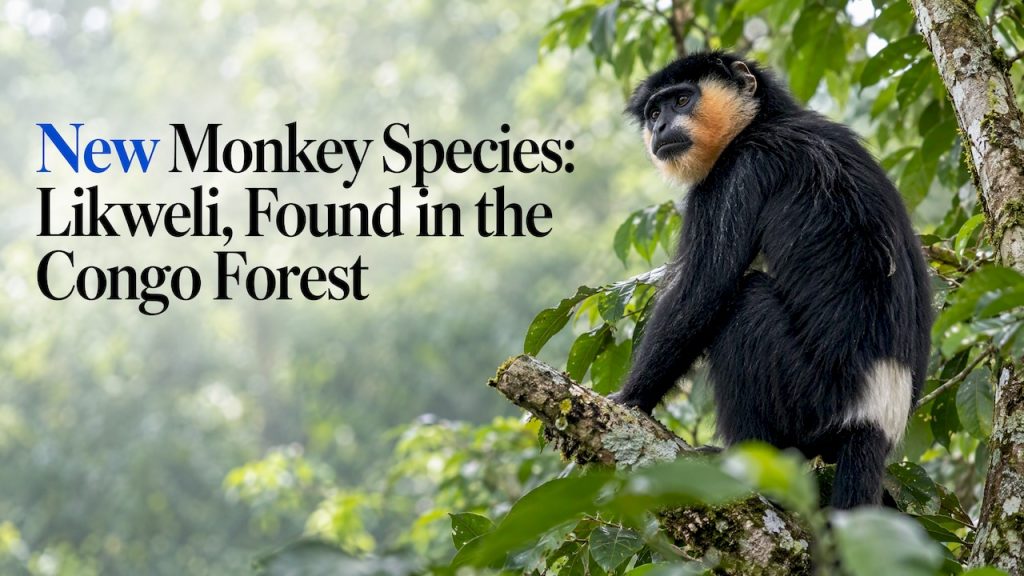
The new monkey species making headlines is Colobus congoensis, known locally as Likweli. Researchers formally described it in a peer-reviewed paper in PLOS One published on 15 July 2026. It is a small, black-furred colobus monkey with an orange-cream patch around its mouth and nose. It lives in high-canopy forest in east-central Democratic Republic of the Congo (DRC), between the Lomami and Congo (Lualaba) rivers. Scientists say it is only the fifth new African monkey species identified in about 75 years, and the authors propose a preliminary Endangered assessment because its range and population appear small.
This article explains what was found, how scientists decided it was a separate species, what the animal looks like, and what the discovery means for conservation.
TL;DR
- What: Colobus congoensis, called Likweli by local people, has been described as a new species of colobus monkey.
- Where: High, closed-canopy forest in and around Lomami National Park, DRC.
- How we know: Field observations, anatomy and genetics all point to the same conclusion, according to the research team.
- Why it matters: Its range is small, hunting and habitat conversion are threats, and the authors recommend a preliminary Endangered assessment.
- What is unknown: A reliable total population estimate does not yet exist.
Table of Contents
- What has been discovered
- Where the Likweli lives
- What the Likweli looks like
- How scientists decided it was a new species
- Behaviour and population
- Why the discovery matters for conservation
- A region in the news for other reasons
- How to read a “new species” headline
- Our perspective
- Follow stories like this on Emadan
- FAQ
- Sources
What has been discovered
The animal is Colobus congoensis, a new species in the colobus group of African monkeys. Local people know it as Likweli. The formal description appeared in PLOS One, an open-access scientific journal, and was accompanied by announcements from the institutions involved, including Yale and Florida Atlantic University.
Colobus monkeys are tree-living primates found across Africa. Until this description, the black colobus, Colobus satanas, was the species most closely related to Likweli. According to Discover Wildlife’s report on the paper, the two species are separated by more than 1,200 km of forest and more than 3.5 million years of evolution.
The finding is rare. Reports of the study describe it as only the fifth new species of monkey described in Africa in the last 75 years. For readers used to headlines about new beetles or deep-sea fish, that rarity is the point: monkeys are large, conspicuous animals, and a new one is an unusual event.
Where the Likweli lives
The researchers report that the species lives in the high-canopy forests of Lomami National Park and nearby areas, in the region between the Lomami and Congo (Lualaba) rivers in east-central DRC. It is largely restricted to high, closed-canopy forest on deep clay pediments and on terra firme forest islands, which are patches of forest on ground that does not flood. This information comes from the PLOS One paper.
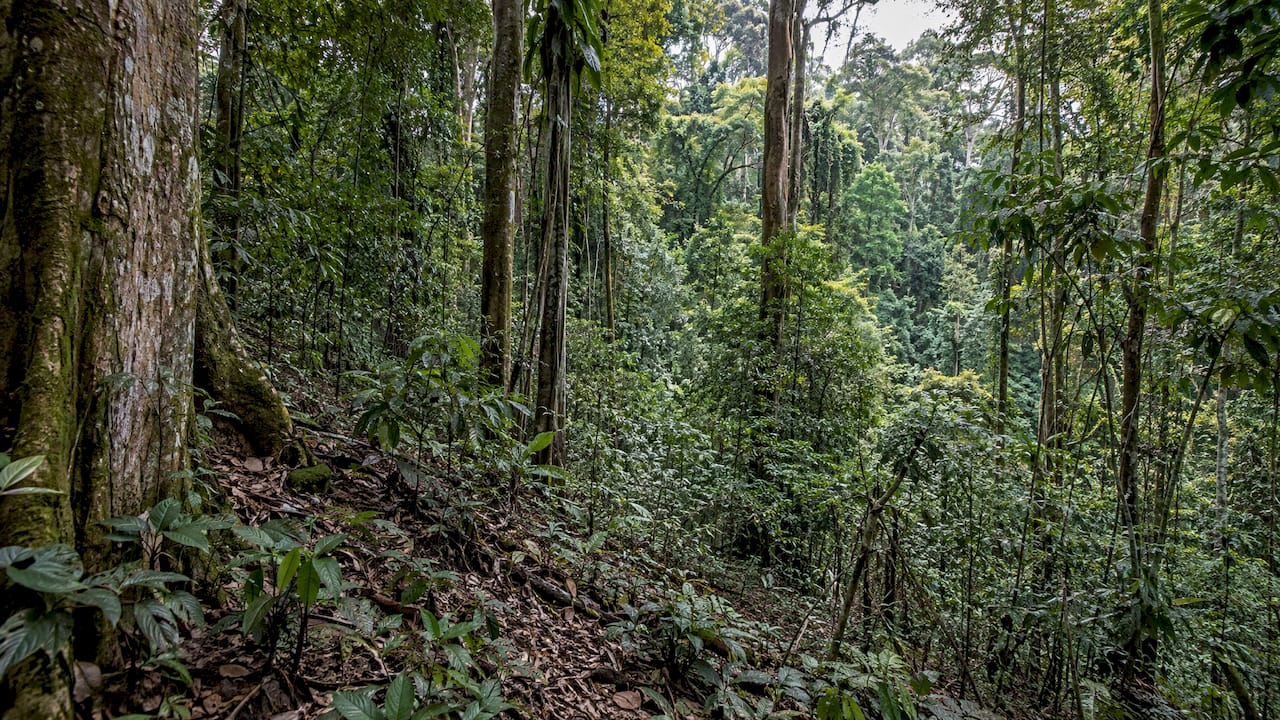
The team made 114 observations between 2018 and 2022. Together they covered an estimated range of about 1,700 square kilometres. That is a small area for a monkey, which is one reason the authors treat the species as vulnerable to change. A range this size leaves little room for the population to move if its forest is cleared or degraded.
What the Likweli looks like
Likweli is a small monkey with black fur. Its most obvious feature is a patch of orange-cream colour around the mouth and nose, which gives the face its mask-like look. It also has a white patch near the base of the tail, according to the PLOS One researchers.
Yale’s account adds further detail. Yale News reports a long tail, black facial hairs, and differences in the skull and teeth when compared with its sister species, the black colobus.
The animal also has a distinctive voice. Discover Wildlife reports that its deep, roaring calls resemble those of related colobus monkeys but have a distinct acoustic structure.
| Feature | Likweli (Colobus congoensis) |
|---|---|
| Fur | Black |
| Face | Orange-cream patch around mouth and nose |
| Tail | Long, with a white patch at its base |
| Habitat | High, closed-canopy forest |
| Typical group size | Averaging 6.2 animals |
| Call | Deep, roaring, with a distinct acoustic structure |
How scientists decided it was a new species
Identifying a new species is not a matter of spotting an unfamiliar animal. Scientists need to show that a population is distinct from all known relatives, and that the difference is consistent and not a local variation.
Here the team relied on several kinds of evidence. According to FAU researcher Kate Detwiler, quoted in the study’s public research summary, the strongest proof came from independent lines of evidence converging on the same species-level conclusion: field traits, anatomy and genetics.
The genetic result is central. Yale News says the split is the deepest known lineage divergence within Colobus, which strengthens the conclusion that Likweli is a separate species and not a regional form of a known one.
In practical terms, the case rests on three questions:
- Does it look different? Yes, in colouring, skull and teeth.
- Does it sound different? The reported calls have a distinct acoustic structure.
- Is it genetically different? The genetic divergence is the deepest recorded within the genus.
Behaviour and population
Likweli generally lives high in the closed forest canopy. It was most often seen in small groups averaging 6.2 individuals, and sometimes alongside other colobine monkeys, according to PLOS One. These mixed-species associations are recorded as common in the observations.
A reliable estimate of the total population is not yet available. That is a normal stage for a newly described species: formal counts usually follow the description, and they depend on surveys in difficult forest terrain.
Why the discovery matters for conservation
The authors say the discovery adds a genetically distinct African primate with unique physical features. It also confirms the importance of Lomami National Park and its buffer zone for protecting the species and the wider primate life of the DRC.
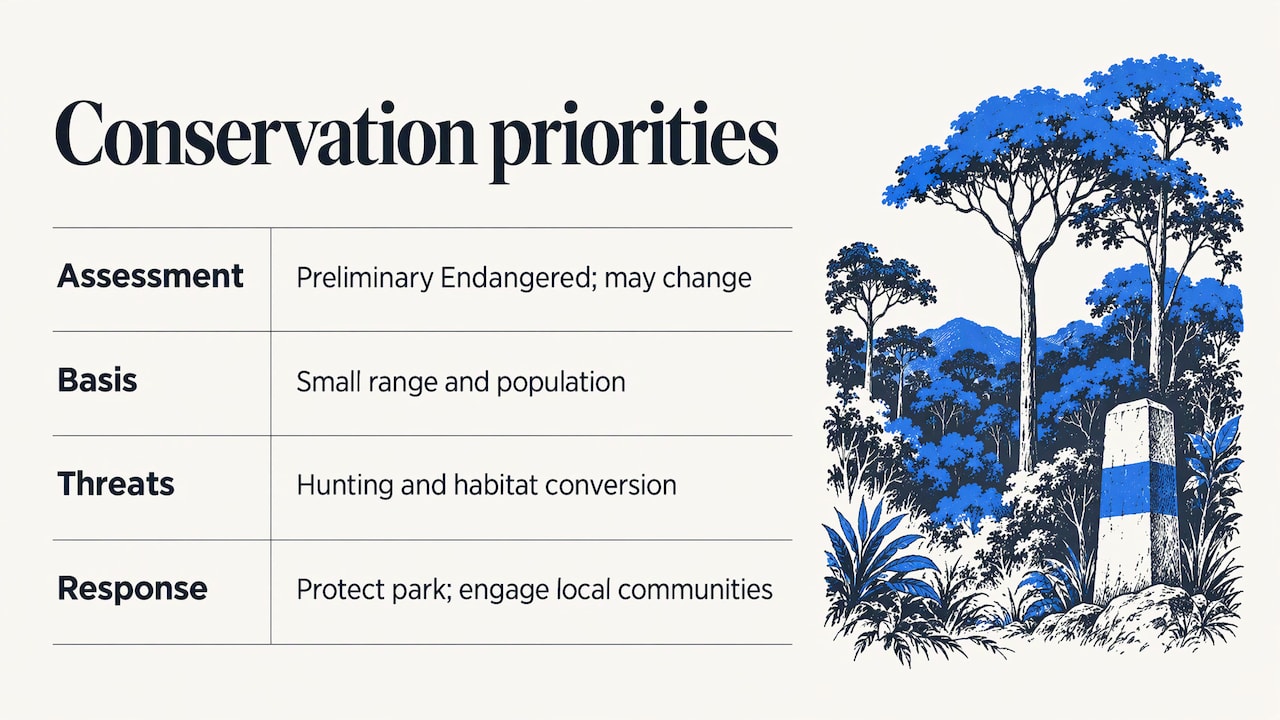
The researchers propose a preliminary assessment of Endangered because of the species’ small range and population. Increased hunting pressure and habitat conversion are among the threats they list. They recommend protecting the park and engaging local communities so that the species is not hunted. All of this is set out in the PLOS One paper.
The authors also read the restricted distribution as a sign that the animal may be especially sensitive to habitat quality, according to the public research summary. The same summary says the finding highlights the importance of Lomami National Park for primate conservation, and how much biodiversity remains undocumented in the Central Congo Basin.
Detwiler is quoted by Discover Wildlife as saying that discovering a new monkey species is extraordinarily rare, and that it shows how urgent it is to protect the small area where this species is found.
A preliminary assessment is not a final one. Formal conservation status is set later, through the usual assessment process, so the label may change as more survey data arrives.
A region in the news for other reasons
The DRC features in global news for many reasons, and the forest regions where wildlife research takes place are also affected by public health and security pressures. For a separate, current example, see our report on the Ebola outbreak in the DRC. It is a reminder that science, conservation and humanitarian stories often share the same geography.
How to read a “new species” headline
Stories about newly identified animals appear regularly, and the wording can mislead. A few points help you judge them.
- “Discovered” and “described” are not the same. Local people often know an animal long before scientists publish it. Likweli already had a local name. The scientific step is the formal description in a journal.
- Look for the paper. The strongest stories link to the peer-reviewed study. This one does, in PLOS One.
- Check the kind of evidence. A single photograph is weaker than anatomy, behaviour and genetics agreeing, which is what the team reports here.
- Treat conservation labels as provisional. The Endangered assessment is described as preliminary.
- Separate the finding from commentary. Quotes from researchers explain why the work matters, but the facts sit in the paper.
This approach applies to science news generally. We apply the same reading to economic reports, which we cover in our guide to reading economic headlines.
Our perspective
Science stories are often told with more drama than the evidence supports. A new monkey species needs no embellishment. The facts are enough: a peer-reviewed description, evidence from three directions, a small range, and a preliminary Endangered assessment that is still to be confirmed.
Our approach at Emadan is to give readers the answer first, then the background. For this story that means naming the species, saying where it lives and what threatens it, and being clear about what is not yet known, such as the total population. We write in plain English because a reader should not need a biology degree to understand why a fifth new African monkey in 75 years is significant.
We aim to verify stories against reputable sources and to correct them promptly. For science news, that means going back to the journal paper and the institutions behind it, and attributing each claim to the people who made it.
ISSB
Follow stories like this on Emadan
Emadan is a news platform that explains global events in plain English. Alongside science, we cover business, politics, technology, sports and world events, with quick-answer summaries, key takeaways and background context in each article. There is nothing to pay and no subscription.

Browse the latest explainers on the Emadan homepage.
FAQ
What is the new monkey species?
It is Colobus congoensis, known locally as Likweli. It is a small, black-furred colobus monkey with an orange-cream patch around its mouth and nose. It was formally described in PLOS One in July 2026.
Where does the Likweli live?
It lives in high, closed-canopy forest in and around Lomami National Park in east-central DR Congo, between the Lomami and Congo (Lualaba) rivers. The researchers estimate its observed range at about 1,700 square kilometres.
Is the Likweli endangered?
The authors propose a preliminary assessment of Endangered because of its small range and population. They name hunting pressure and habitat conversion among the threats. The formal status may change once further surveys are completed.
How rare is it to find a new monkey species?
Very rare. Reports on the study say it is only the fifth new monkey species described in Africa in the last 75 years, according to Discover Wildlife.
How many Likweli are there?
Nobody knows yet. The study says a reliable total population estimate is not available. Researchers recorded 114 observations between 2018 and 2022, and groups averaged 6.2 animals.
Sources
- Likweli: A remarkable new species of Colobus monkey (PLOS One)
- Meet ‘Likweli’: A new monkey species discovered in the Congo Basin (Yale News)
- New species of monkey with unusual orange lips discovered (EurekAlert)
- Mysterious new monkey species with orange lips discovered in the Congo rainforest (Discover Wildlife)